
Tongue Tie in Babies: A Gentle Guide for New Parents
Is your baby struggling to latch, feeding for hours, or making clicking sounds while nursing? Tongue tie in babies is one of the most common, and most misunderstood, reasons behind early feeding difficulties.
The good news is that tongue tie in babies is easy to assess, and when treatment is needed, it is usually quick and simple. The key is knowing which signs matter, and getting a proper functional assessment rather than a guess based on how the tongue looks.
In this guide, we explain what tongue tie in babies is, the warning signs to watch for, how it can affect feeding and speech, and the treatment options available, so you can make a calm, informed decision for your child.
What Is Tongue Tie in Babies?
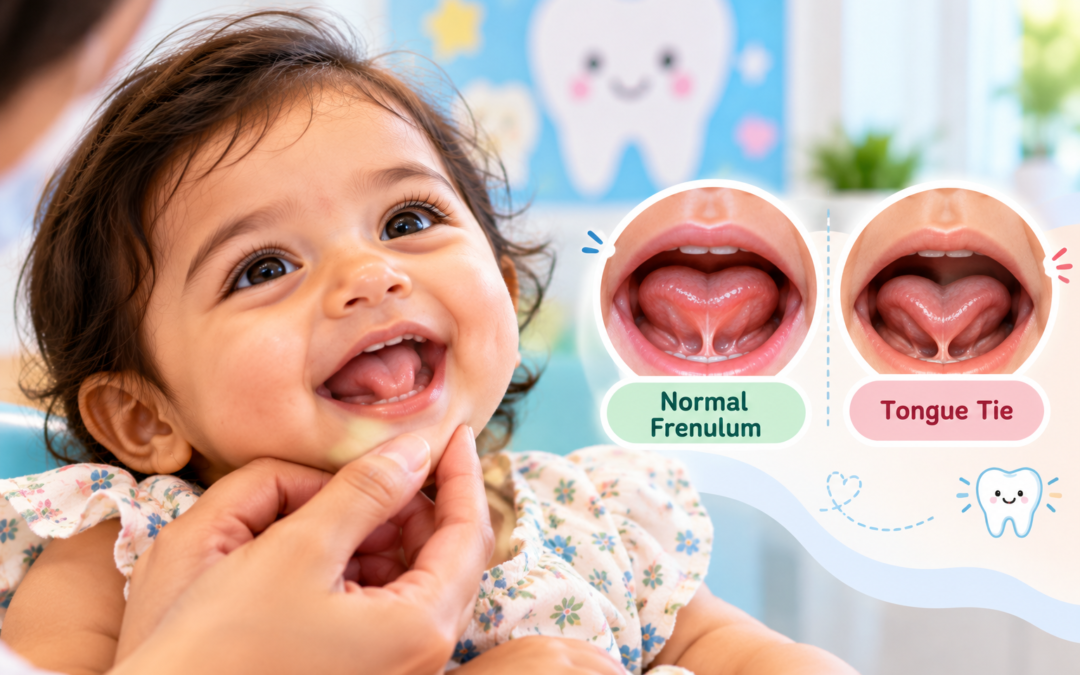
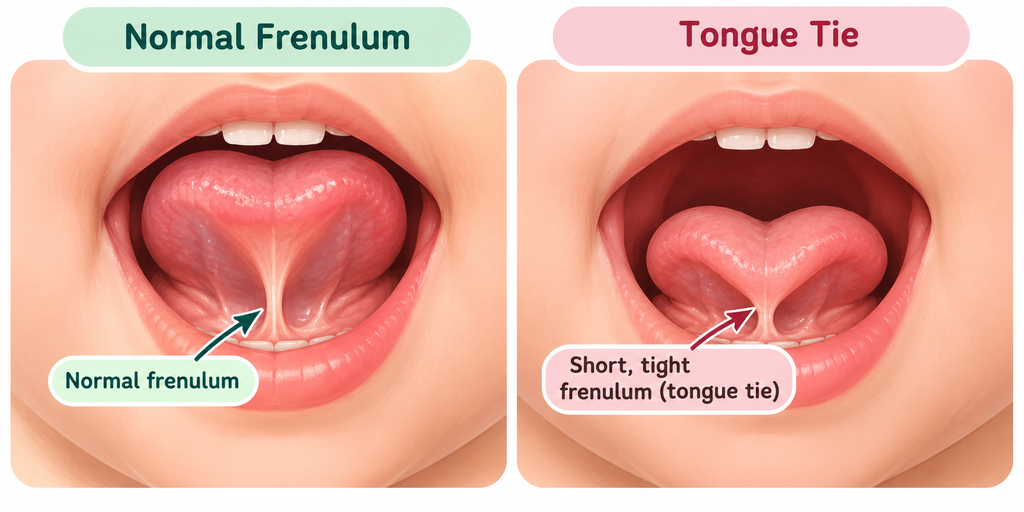
Everyone has a small band of tissue under the tongue called the lingual frenulum. Tongue tie in babies, medically called ankyloglossia, happens when this band is unusually short, tight or thick, and it limits how freely the tongue can move.
A baby’s tongue needs to lift, stretch forward and move side to side to feed well. When the frenulum holds it down, feeding, and later eating and speech, can become harder.
Types of tongue tie
- Anterior tongue tie: The band attaches close to the tip of the tongue and is usually easy to see. The tongue tip may look notched or heart-shaped when the baby cries or sticks it out.
- Posterior tongue tie: The restriction sits further back, under the mucous membrane, and is harder to see. It is often found only when a trained clinician feels under the tongue and checks how it moves.
How common is tongue tie in babies?
Studies estimate that tongue tie in babies affects roughly 4 to 11 in every 100 newborns, depending on how it is defined. It is more common in boys and often runs in families. Many babies with tongue tie also have a lip tie, where the band joining the upper lip to the gum is tight.
tongue tie in Babies
7 Warning Signs of Tongue Tie in Babies
The signs of tongue tie in babies show up mainly during feeding. Watch for these:
- Difficulty latching or staying latched – the baby slips off the breast or bottle often.
- Clicking or smacking sounds while feeding, which can mean the baby is losing suction.
- Very long or very frequent feeds – the baby seems hungry soon after a feed that lasted an hour.
- Slow weight gain despite frequent feeding.
- Milk dribbling from the corners of the mouth.
- Gassiness, fussiness or reflux-like symptoms, often from swallowing air during feeds.
- Limited tongue movement – the tongue cannot lift towards the roof of the mouth, cannot stick out past the lower lip, or looks heart-shaped at the tip.
Signs in the breastfeeding mother
Tongue tie in babies can also affect the mother. Common signs include:
- Nipple pain that continues beyond the first week or two of breastfeeding
- Cracked, bleeding or flattened nipples, shaped like a new lipstick after feeds
- Blocked ducts or mastitis
- A drop in milk supply, because the baby cannot drain the breast well
One sign alone does not confirm a tongue tie. Many of these problems have other causes, such as positioning, which is why a full assessment matters.
How Tongue Tie in Babies Can Affect Your Child
Not every tongue tie causes problems. Some babies feed well and never need treatment. When tongue tie in babies does restrict function, the effects can include the following.
Feeding
This is the most common and best-supported effect. A restricted tongue cannot cup the nipple and create the wave-like motion needed for efficient feeding. This can lead to poor weight gain, a tired and frustrated baby, and a painful experience for the mother. Bottle-fed babies can be affected too.
Eating solid foods
As children start solids, a tight tongue may make it harder to move food around the mouth, leading to gagging, slow eating or a preference for soft foods.
Speech
Some children with tongue tie have difficulty with sounds that need the tongue tip to lift, such as t, d, n, l, r and th. However, many children with tongue tie speak perfectly clearly. Speech problems are not a reason by themselves to treat a baby early; a speech therapist’s assessment helps later if concerns arise.
Oral health
Limited tongue movement can make it harder for a child to clear food from the teeth, which may raise the risk of cavities. An associated lip tie can make brushing the upper front teeth difficult.
What is still debated
Links between tongue tie in babies and problems like sleep-disordered breathing or jaw development are discussed, but the evidence is still limited. A responsible clinician bases treatment on clear functional problems, not on appearance or every possible symptom.
How Is Tongue Tie in Babies Diagnosed?
Diagnosing tongue tie in babies is about function, not just looks. A frenulum that looks tight may cause no problems, while one that looks normal may restrict movement.
A thorough assessment by a pediatric dentist usually includes:
- A feeding history – how long feeds take, weight gain, and any pain or problems for the mother.
- A gentle examination – looking at where the frenulum attaches and how thick and stretchy it is.
- A tongue function check – how well the tongue lifts, extends, moves side to side and cups a gloved finger.
- A lip check – looking for an associated lip tie.
- Structured tools – clinicians may use recognised scoring tools such as the Bristol Tongue Assessment Tool or the Hazelbaker assessment.
The best outcomes come from teamwork. Your pediatric dentist may work with a lactation consultant to correct positioning and latch, and with your pediatrician to rule out other causes of feeding difficulty.
Treatment Options for Tongue Tie in Babies
Treatment for tongue tie in babies depends on how much the tie affects feeding and function, and on the baby’s age.
| Option | What it involves | Best suited for |
|---|---|---|
| Watchful waiting + feeding support | Lactation help with latch and positioning; regular review | Mild ties with no clear feeding problems |
| Frenotomy (scissors) | A quick snip of the frenulum with sterile scissors; takes seconds, minimal bleeding | Young babies with feeding difficulty |
| Laser frenotomy | The frenulum is released with a dental laser, which seals tissue as it works | Anterior and posterior ties, depending on the clinician’s assessment |
| Frenuloplasty | A more extensive release, sometimes with stitches, often under anaesthesia | Older children or thick ties not suited to a simple release |
What happens during a frenotomy?
For young babies, a frenotomy is usually done in the clinic. The baby is swaddled and held securely, the tongue is lifted gently, and the frenulum is released in a few seconds. Most babies cry briefly, mainly from being held, and settle quickly. Many are offered a feed straight after, which comforts them and helps the clinician see the change.
Is treatment for tongue tie in babies safe?
When done by a trained clinician, frenotomy is considered a low-risk procedure. Possible risks include minor bleeding, infection (rare), temporary feeding fussiness, and reattachment of the tissue as it heals. Your clinician should explain these clearly before any procedure.
Aftercare and Healing After Tongue Tie Release
Healing after treatment for tongue tie in babies is usually quick. Here is what to expect:
- First 24–48 hours: Some fussiness is normal. Skin-to-skin contact and frequent feeds help comfort your baby.
- Days 2–7: A white or yellowish diamond-shaped patch forms under the tongue. This is normal healing tissue, not infection.
- Weeks 1–2: The wound gradually heals and the patch fades.
- Weeks 2–4: Feeding often improves further as your baby learns to use the newly freed tongue.
Your clinician may recommend gentle wound care exercises and continued lactation support. Follow their specific advice, as aftercare routines vary between clinicians.
Call your clinician if you notice bleeding that does not stop with gentle pressure, a fever, refusal to feed, or swelling that gets worse instead of better.
When to See a Specialist for Tongue Tie in Babies
Book an assessment for tongue tie in babies if:
- Feeding is painful for the mother beyond the first one or two weeks
- Your baby struggles to latch, feeds for very long periods, or is gaining weight slowly
- You notice clicking, milk leaking or a heart-shaped tongue tip
- Your pediatrician or lactation consultant suspects a tie
- An older child has difficulty eating, cleaning the teeth or with certain speech sounds
Early assessment is ideal, ideally in the first weeks of life when feeding problems are most stressful and treatment is simplest.
Tongue Tie Treatment in Anna Nagar at Velora Dental Care
At Velora Dental Care, Anna Nagar, tongue tie in babies is assessed by Dr. Janani J, MDS (Pediatric and Preventive Dentistry), who has a special clinical focus on tethered oral tissues, including tongue tie and lip tie.
Parents choose Velora for:
- Function-first assessment – we treat only when a tie is genuinely affecting feeding or function, never based on appearance alone.
- Clear, honest guidance – you will understand your baby’s assessment and every option, including when no treatment is needed.
- Gentle, baby-centred care – a calm environment and careful handling throughout.
- Teamwork – coordination with lactation consultants and pediatricians for complete feeding support.
- Follow-up – support through healing and feeding recovery.
Worried about tongue tie in your baby? Call or WhatsApp +91 73050 78470 to book an assessment.
Frequently Asked Questions
Does every tongue tie in babies need to be treated?
No. Treatment is recommended only when the tie clearly affects feeding or function. Many babies with a visible frenulum feed well and need no procedure.
Is tongue tie release painful for babies?
The procedure takes only seconds. Most babies cry briefly, mainly from being held, and settle quickly, often with a feed straight afterwards.
What is the best age to treat tongue tie?
When feeding is affected, assessment in the first few weeks of life is ideal. The procedure is simplest in young infants, but older children can be treated too.
Can tongue tie fix itself?
The frenulum may stretch slightly as a child grows, and some babies learn to feed around a mild tie. A tight tie that restricts movement does not usually resolve on its own.
Will tongue tie affect my child’s speech?
Not always. Many children with tongue tie speak clearly. If speech concerns appear later, a speech therapist and pediatric dentist can assess whether the tie plays a role.
Where can I get tongue tie in babies assessed in Anna Nagar?
Velora Dental Care in Anna Nagar offers functional tongue tie assessments by a pediatric dentist. Call or WhatsApp +91 73050 78470.
Conclusion
Tongue tie in babies can make the early weeks of feeding stressful, but it is very manageable. Watch for the warning signs, ask for a proper functional assessment, and remember that treatment is only one option among several.
Book a gentle tongue tie assessment at Velora Dental Care, Anna Nagar. Call or WhatsApp +91 73050 78470 today.